Age-related differences in statistical learning of non-adjacent dependencies: Evidence from ERPs
Abstract
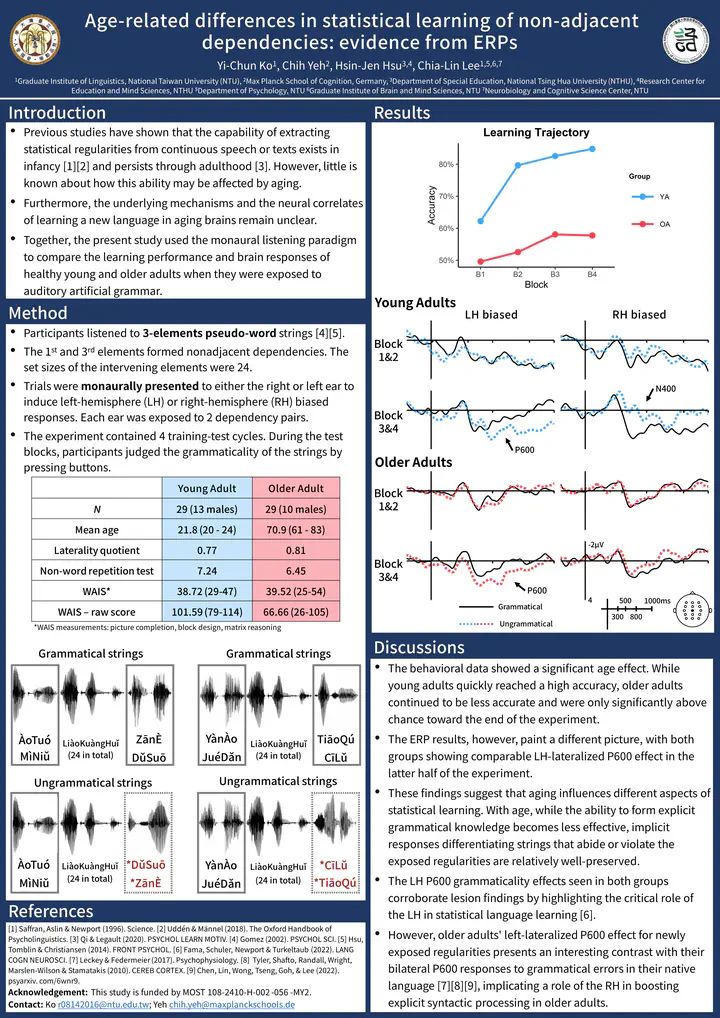
Detecting statistical regularities is key to language acquisition. Studies have shown that the capability of extracting statistical regularities from continuous strings such as speech exists in infancy and persists into adulthood. However, little is known about how this ability is affected by aging. To gain a basic understanding of statistical learning ability of older adults, the present study recorded event-related potentials (ERPs) of a group of young adults (YA, N = 29; age range = 20-24 years) and a group of older adults (OA, N = 24; age range = 61-83 yrs) who monaurally learned and judged the grammaticality of 3-element pseudoword strings generated according to predetermined artificial grammar rules. The experiment was conducted in four training-test cycles. The results showed that older adults were significantly less accurate in grammaticality judgment than were younger adults (averaged accuracy from the last two cycles: OA = 56% and YA = 84%). Nevertheless, like young adults, older adults showed a unilateral left-hemisphere P600 grammaticality effect. Relative to grammatical strings, ungrammatical strings elicited a P600 response when perceived through the right ear, but elicited a sustained negativity when perceived through the left ear. These data present an interesting contrast to prior observations of bilateral syntactic processing in older adults when processing native languages. Together, these findings suggest that aging influences different aspects of statistical learning. Older adults, while being able to implicitly distinguish strings that adhere to or violate the exposed regularity, are less able to make explicit grammatical judgments based on this knowledge.