Referential ambiguity resolution for multiple referents: Evidence from event-related potentials
Abstract
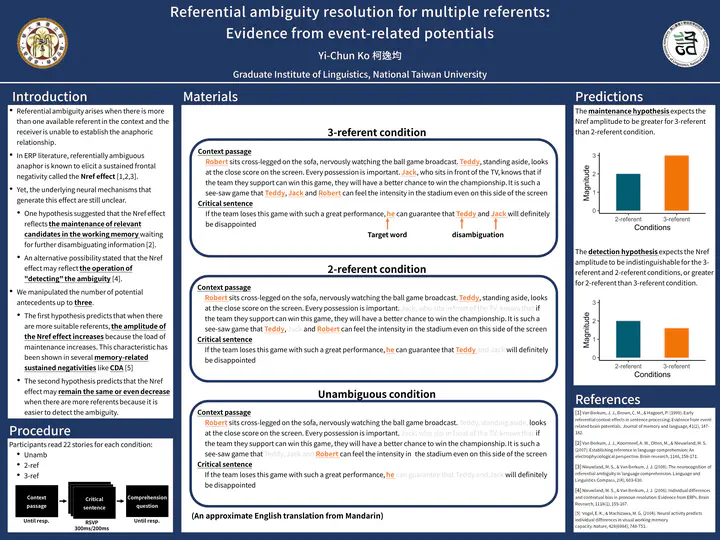
Establishing reference is essential to successful discourse comprehension. Specifically, pronoun is a referential indicator containing less semantic meaning that requires a co-reference dependency with a previously mentioned antecedent. However, referential ambiguity arises when there are more than one referent is available in the context and the receiver is unable to establish the anaphoric relationship. This referentially ambiguous anaphor is known to elicit a sustained frontal negativity called the Nref effect in ERP literature [7, 9] Previous studies have shown that the Nref effect was elicited using both written and spoken ambiguous anaphors [5,7,8,10] and it reflected situation model-level instead of superficial lexicallevel ambiguity [4]. Yet, the underlying neural mechanisms that generate this effect is still unclear. One possible hypothesis suggested that the Nref effect reflects the maintenance of relevant candidates in the working memory waiting for further disambiguating information [9], whereas an alternative possibility stated that the Nref effect may reflect the operation of ”detecting” the ambiguity [5]. However, the extant literature is limited in providing critical evidence to distinguish these two hypotheses due to the experimental designs. Previous studies are restricted to examining the referential ambiguity arises from having two possible referents [1, 2], which yields results that can be equally well explained by both hypotheses. In this present study, we manipulate the number of potential antecedents up to three. Participants read a passage with one to three characters before reading the critical sentence that contains an ambiguous pronoun.(See Table 1) After the critical sentence, a comprehension question regarding either passage comprehension or pronoun resolution is then presented to encourage the participants to not only focus on the story but also resolve the ambiguous pronoun. The aforementioned two competing hypotheses make different predictions for the three-referent condition in that the active-maintenance hypothesis should expect the magnitude of the Nref increase as the number of items to be held increases, similar to several memory-related sustained negativities that have been reported in the literature [3, 6, 11, 12]. Alternatively, the detection hypothesis would expect equivalent Nref effect regardless of the number of referential candidates. The results of present study may provide a critical basis for revising existing theories. Clarifying the fundamental characteristics and functional significance of the Nref effect could thus help clarify the underlying mechanisms of referential processing.