Right hemisphere syntactic processing in demanding conditions: An event-related potential study
Abstract
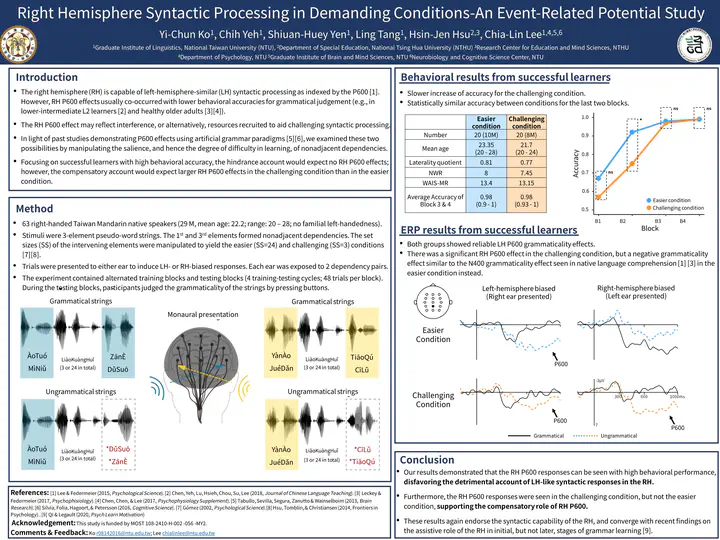
The right hemisphere (RH) has been found to possess left hemisphere (LH) equivalent syntactic processing ability as indexed by the P600s to some grammatical errors. RH P600s, however, are sometimes associated with lower behavioral accuracy for grammaticality judgment (e.g., in moderate L2 learners or healthy older adults), and such association could reflect a detrimental effect for syntactic processing (due to potentially conflicting outputs across hemispheres) or compensatory attempts from the RH under more challenging processing conditions. To clarify, we recorded Event-Related Potentials (ERPs) from 67 young right-handers while they monaurally learned and judged the grammaticality of 3-element strings generated based on predetermined artificial grammar rules- non-adjacent dependencies between the 1st and last elements. We additionally manipulated the difficulty level of learning these dependencies by varying the size of the set from which the intervening 2nd elements were drawn, creating salient (i.e., easier to learn) and less salient (more difficult to learn) dependencies. To adjudicate between the two possible accounts for the RH P600, we focused on successful learners only and contrasted ERPs over the last 2 blocks to include data only after high proficiency was attained. Despite comparably high behavioral performance, we found a LH-only P600 effect in the easier condition (accuracy=0.98%, N=20), but bilateral P600 effects in the more challenging condition (accuracy=0.98%, N=20). These results thus disfavor the hindrance account of the RH P600 responses, and instead support the compensatory role of the RH P600 in challenging syntactic processing/learning tasks.