Vowel lowering effect of pharyngeal and uvular consonants in Squliq Atayal
Abstract
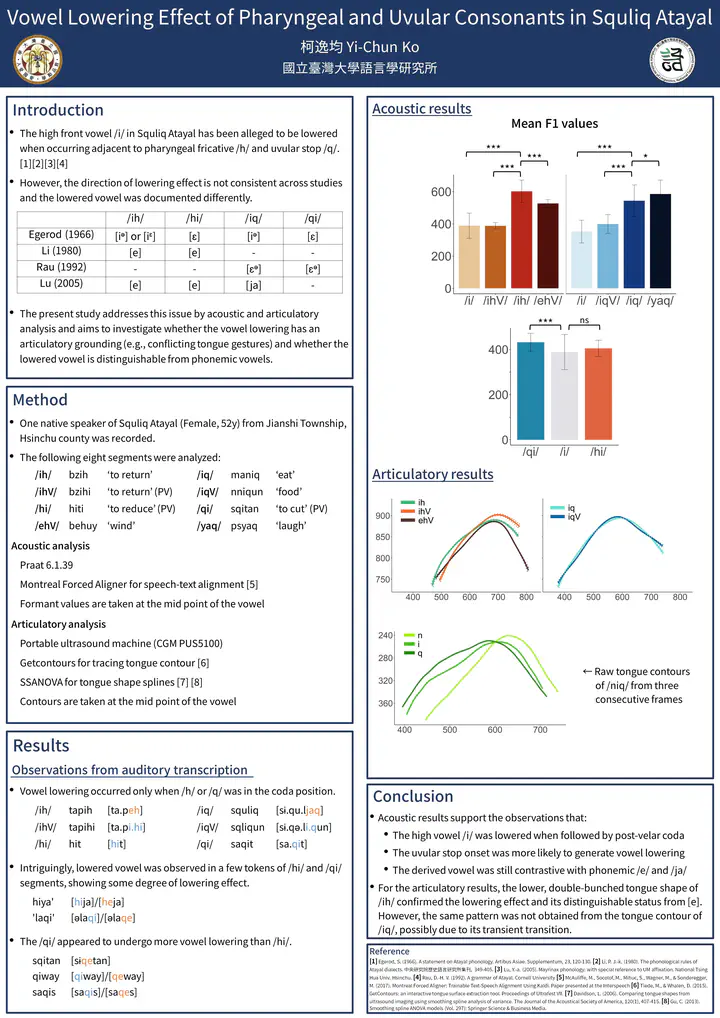
High vowel in Squliq Atayal has been alleged to be lowered when occurring adjacent to pharyngeal and uvular consonants /h/ and /q/ (Egerod, 1966; Li, 1980; Rau, 1992). However, the observed lowering of the high vowels are heavily based on auditory transcription with no further examination on its underlying mechanism. The present study investigates the patterns of the vowel lowering effect in Squliq Atayal through acoustic and articulatory analyses, specifically for high front vowel /i/ that is either preceded or followed by /h/ and /q/. Recordings and Ultrasound data were collected from one native speaker of Squliq Atayal. The acoustic results show a vowel lowering effect interacts with syllable structure, while the lowered vowel is still distinguishable from phonemic /e/ and /ya/. Ultrasound data confirm that for the vowel in /ih/, the tongue is more retracted toward the pharynx with a still clear palatal constriction, forming a double bunched tongue shape. This suggests that the vowel quality of /i/ is affected by the following consonants, though remaining contrastive from another phoneme /e/ as acoustic analysis has indicated. For vowels in /iq/, however, the SSANOVA results show no clear retraction, possibly due to a transient transition from /i/ to /q/. In sum, the present study provides acoustic and articulatory evidences showing that in Squliq Atayal, the high front vowel /i/ is lowered when followed by post-velar coda and this lowering may be resulted from articulatory gestures. We conjecture that the tongue root of /i/ is retracted possibly due to an anticipatory coarticulation. The fact that the retracted /i/ is not identical with /e/ acoustically and articulatory may provide important insight into the decision of writing system.